Proactive Power Monitoring Identifies $3M in Unrealized Savings
How a major U.S. data center operator used 8 kHz waveform monitoring to detect rectifier degradation across 800+ units below alarm thresholds, achieving up to 6:1 ROI with a 5-month payback.
Undetected Degradation
Of monitored rectifiers showed degradation below alarm thresholds
3-Year Value
Across conservative to optimistic scenarios
ROI
With 5-month payback period
Standard Alarms
All degradation missed by existing monitoring
This represents a strategic shift in how we manage critical infrastructure. Verdigris Signals gives us visibility into degradation patterns that standard monitoring misses, enabling us to maintain our reliability leadership position while optimizing capital allocation.
The Challenge
A major U.S. data center operator faced a critical maintenance dilemma across 800+ rectifiers in mission-critical network facilities. Neither approach to maintenance was working:
Reactive maintenance (waiting for failures) led to expensive emergency callouts at $8,000 to $12,000 each, with service disruption risk during peak load or maintenance windows.
Time-based replacement (fixed schedules) wasted capital replacing healthy equipment, treating all 800 rectifiers equally on 10-year cycles regardless of actual condition.
Existing RMS-based monitoring confirmed operation within spec but failed to detect gradual degradation below alarm thresholds. The engineering team lacked visibility into long-term equipment health needed to support condition-based maintenance, directing resources based on electrical evidence, not assumptions.
Without this insight, the operator risked overspending on premature replacements or underinvesting in degrading assets, increasing the likelihood of facility-level events.
The Approach
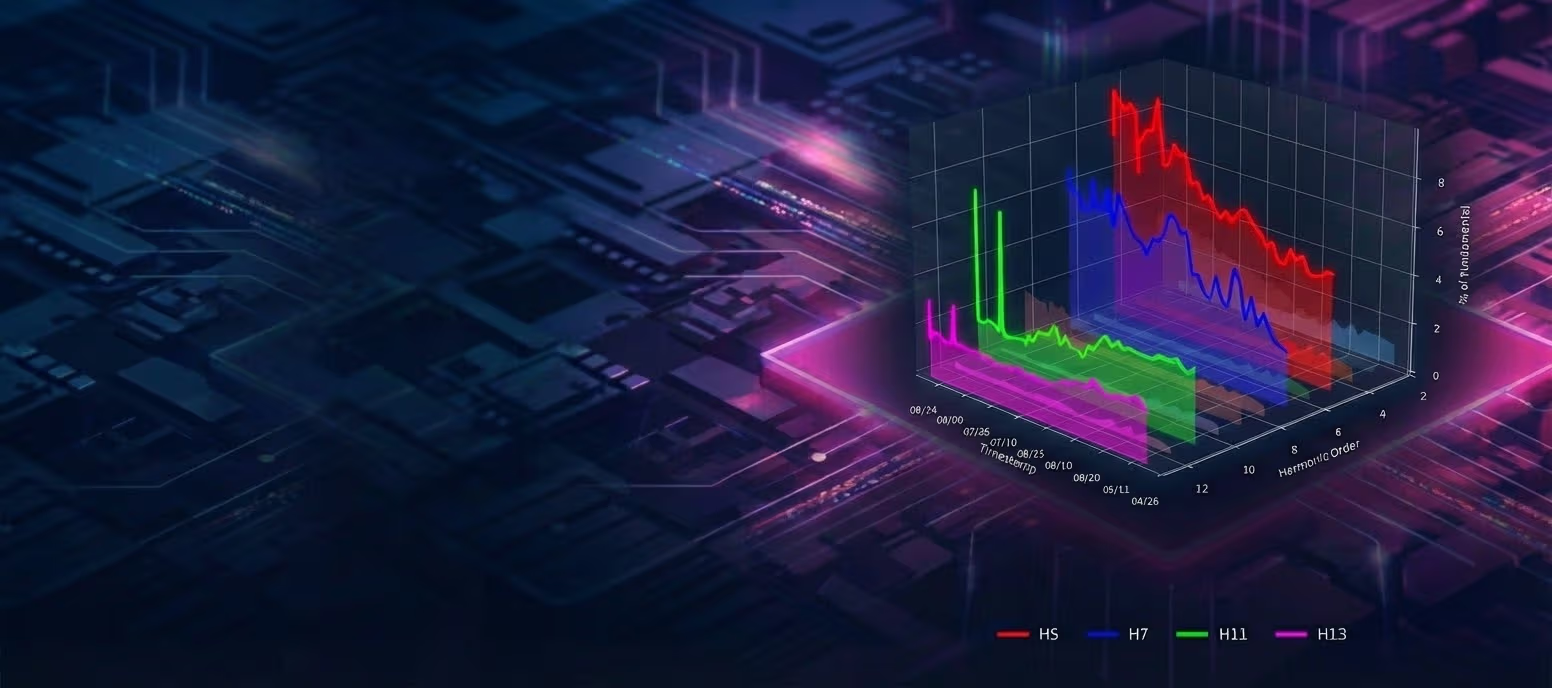
Verdigris deployed high-resolution power monitors capturing continuous waveforms at 8 kHz sampling rate, preserving electrical signatures that existing 1 Hz RMS monitoring eliminates through averaging.
Technical Differentiation
| Capability | Existing BMS | Verdigris |
|---|---|---|
| Sampling rate | 1 Hz (1/second) | 8 kHz (8,000/second) |
| Harmonic analysis | None | 5th & 7th THD |
| Detection method | Static thresholds | Directional trending |
| Early warning | None | 48+ hours |
Four capabilities set this approach apart:
- High-resolution waveform capture preserves harmonic content indicating component stress: capacitor aging, diode degradation, thermal effects
- Automated harmonic extraction identifies health biomarkers: 5th and 7th orders for 6-pulse rectifiers
- Comparative analytics compares rectifiers on shared DC plants, eliminating false positives from supply/load variations
- Long-duration trending detects persistent changes over weeks and months, not point-in-time snapshots
The analysis focused on characteristic harmonics as "health biomarkers," comparable to how blood tests detect early disease before symptoms appear. Rather than static thresholds, the system identified directional trends: persistent increases in harmonic magnitudes correlated with elevated current under similar operating conditions.
The Results
About 32 of 800 monitored rectifiers (4%) exhibited statistically significant degradation trends that existing monitoring missed entirely.
All units remained within power-quality limits with zero alarms triggered. Degrading rectifiers showed persistent harmonic increases not present in the ~768 stable peer assets operating under identical conditions, a high signal-to-noise ratio providing clear maintenance targets.
Financial Impact
The analysis projected $1.3M to $3.0M in 3-year value against an investment of approximately $500K, delivering 3:1 to 6:1 ROI with a 5 to 13 month payback period. The range reflects conservative to optimistic scenario modeling; individual value categories vary based on failure rates, fleet composition, and maintenance contract terms.
Value Breakdown
The table below shows the most-likely scenario ($1.6M–$2.4M). The full $1.3M–$3.0M range extends to conservative and optimistic assumptions around failure rates, fleet composition, and maintenance contract terms.
| Category | Description | 3-Year Value |
|---|---|---|
| Emergency Callout Reduction | Early intervention reduces reactive emergency response by 30 to 40% | $540,000 |
| Extended Equipment Life | 96% of rectifiers show no degradation, extend replacement cycles 15 to 20% with confidence | $900K to $1.5M |
| Optimized Preventive Maintenance | Focus inspections on ~32 degrading units vs fleet-wide approach | $120K to $225K |
| Avoided Premium Costs | Planned maintenance uses standard lead times vs expedited shipping (20 to 30% premium) | $60K to $135K |
Why This Matters
Beyond the direct financial return, this deployment addresses strategic concerns that matter at the board level:
Avoid catastrophic cost. 43% of telecom outages stem from power failures. Preventing even 1 to 2 facility-level events ($2M to $5M each) justifies the investment alone.
Brand protection. Outages make headlines and drive churn. AT&T's 2024 failure cost $140M+ in credits, triggered Congressional inquiry, and eroded subscriber trust.
Stakeholder assurance. Demonstrable predictive maintenance signals operational maturity to boards, investors, and regulators, with FCC scrutiny intensifying post-2024.
Competitive advantage. While peers react to failures, this operator predicts and prevents them, transforming reactive response into proactive detection.
What's Next?
Following validation across ~800 rectifiers, the operator is expanding Verdigris intelligence-driven maintenance:
- Phase 1 (current): Full deployment to highest-criticality network facilities with Verdigris Signals platform for early degradation detection
- Phase 2 (planned): Extension to UPS systems and backup generators, applying the same early detection methodology to all critical power infrastructure
- Phase 3 (strategic): Building infrastructure intelligence as competitive advantage
This expansion reflects strategic value recognized by engineering and finance teams: this isn't only cost optimization, it's operational transformation. The operator had deployed premium DCIM infrastructure from market-leading providers, yet ~32 rectifiers were degrading, completely missed by incumbent platforms.