Making electricity visible since 2011
We build the sensing and analytics that reveal what's actually happening inside electrical systems. The electrical signal carries more information than legacy instruments were designed to see.
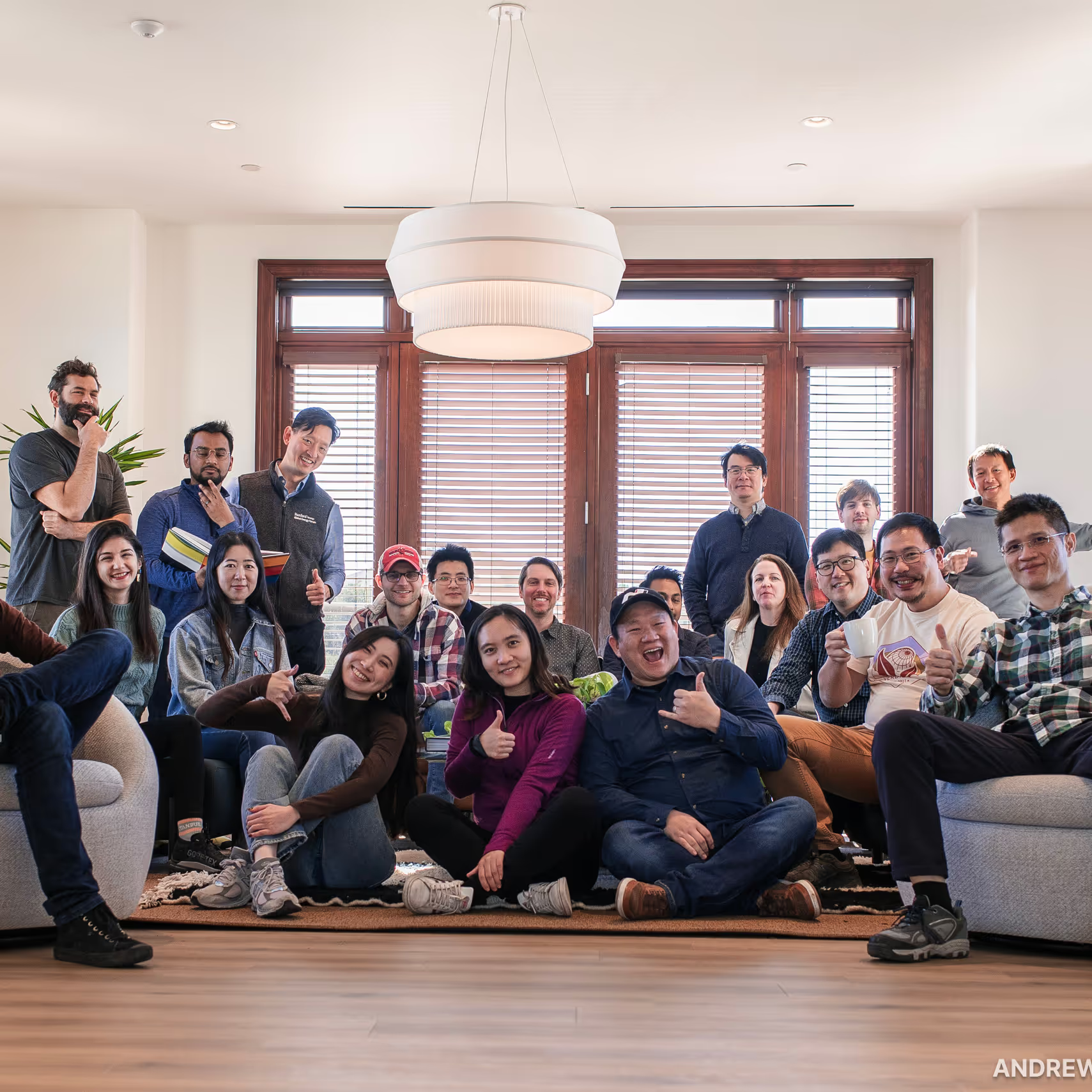
Verdigris builds the sensing and analytics that reveal what's actually happening inside electrical systems, from commercial buildings to industrial facilities to the GPU-dense data centers now powering AI.
The electrical signal carries more information than legacy instruments were designed to see. We capture it at sub-cycle resolution, interpret it with physics and machine learning, and turn it into decisions operators can act on: where capacity is stranded, where failure is forming, where a load is behaving in ways no averaged dataset would reveal.
Our mission has been constant since 2011: sustain and enrich human life through responsive energy intelligence. The infrastructure has changed. The mission hasn't.
Built in silicon
The work that became Verdigris started in the semiconductor industry. Mark Chung designed memory and circuit systems at AMD. Thomas Chung worked on sparse matrix solvers and advanced chip-design tooling at the same company. Jonathan Chu began his career as a research scientist at IBM on next-generation silicon.
Mark and Jon converged at NetLogic, building some of the most advanced network processors of the era. Along the way, they developed an algorithm that could extract meaningful signal from a single stream of noisy data. That technique stayed with them.
In 2008, a $600 utility bill arrived at Mark's house. No tool could explain it. The question sharpened with the arrival of their children. What they knew about silicon and signal had a new place to go.
They founded Verdigris in 2011. Thomas, Mark's brother, rejoined to build something that mattered. The early thesis: humans drove energy consumption, and better insight would change behavior. For over a decade, Verdigris instrumented the buildings and factories that form the backbone of the economy.
That thesis turned out to be only half right.
Returning to silicon
Zico Kolter reconnected with the team, now on the OpenAI board. He and Mark had shared a graduate advisor at Stanford years before, and that connection first brought non-intrusive load monitoring into Verdigris's early work. Chiqun Zhang, Verdigris's former head of data science, was working on GPUs at Microsoft. Transformer models were emerging. Conversations that had drifted over the years converged again.
The realization was direct: the most important energy consumer of the coming decade would not be human. It would be silicon.
Fifteen years of power-system instrumentation, combined with the team's original expertise in silicon and single-stream signal extraction, turned out to be the capability the AI era would demand. A single rack of high-density GPU compute draws over 120 kW of pulsating, non-linear load. The harmonics and transients those systems produce live where older instruments were never designed to look.
The mission has not changed. The load has. The team built to understand it started in silicon, and has returned to it at the scale this era requires.
Trusted by Teams Operating Critical Infrastructure
Trusted by teams operating critical infrastructure worldwide.







Recognition




Backed By







Technical / AI
Yoky Matsuoka
CEO, Panasonic Well; Co-founder, Google X; MacArthur Fellow
J. Zico Kolter
Head of Machine Learning Department, Carnegie Mellon University; Chief Scientist, Bosch AI
Deepak Ramachandran
Google DeepMind
Founders
Michael Baum
Founder, Splunk
Joshua Schachter
Founder, Delicious
Enterprise / Infrastructure
Andy Brown
Former Group CTO, UBS; Board Director, Zscaler and Pure Storage
Pat Finn
CRO, Pure Storage; Former SVP U.S. Public Sector, Cisco
Doug Mouton
Former Senior Engineering Leader, Microsoft and Meta; Board Director, Riot Platforms
JP Rosato
Founder, CS Technology (acquired by Accenture); Operating Partner, DigitalBridge
Semiconductor / Hardware
Dhiraj Mallick
COO, Cerebras Systems
Behrooz Abdi
Former CEO, InvenSense (TDK); Former SVP and GM, Qualcomm
Fred Weber
Former CTO and Corporate VP, AMD; Member, National Academy of Engineering
Sanjay Lall
CRO, proteanTecs; Former EVP, Cadence Design Systems
Finance / Real Estate
John S. Willian
Former Global Head of FICC Sales, Goldman Sachs
Dennis R. Irvin
Former President and CEO, Rockefeller Group Investment Management
Christopher Kelly
Former Chief Privacy Officer and General Counsel, Meta
Telecom / Industry
Jonathan Spalter
President and CEO, USTelecom
Mark Smith
Former Managing Director, Verizon Ventures
Strategic Capital
Louisa and Philip Liao
Walsin Lihwa Corporation (global wire and cable manufacturer)
Advisors who have shaped the company. Nearly every one has a pre-existing relationship with the team. They know our capabilities because they've watched us build.
Where We're Going
The system boundary of silicon is shifting. What was once a multithreaded CPU is now parallel GPUs coordinated at the rack, the row, and the AI factory. Energy and compute are no longer separate system problems. They are the same problem, expressed in the same signal.
Verdigris sits where those systems meet, in the signal between the power that moves through critical infrastructure and the compute that now shapes nearly every industry. The grid is being asked to do more: power AI, absorb renewables, stay reliable under loads it was not designed for. Electrical intelligence is how that grid becomes responsive rather than reactive.
We are building toward that future, one circuit at a time.