Bringing intelligence to the cable layer
A Southwire + Verdigris perspective on power delivery in the AI era. Why the cable layer is the next frontier for observability and how we're building toward an intelligent interconnect.
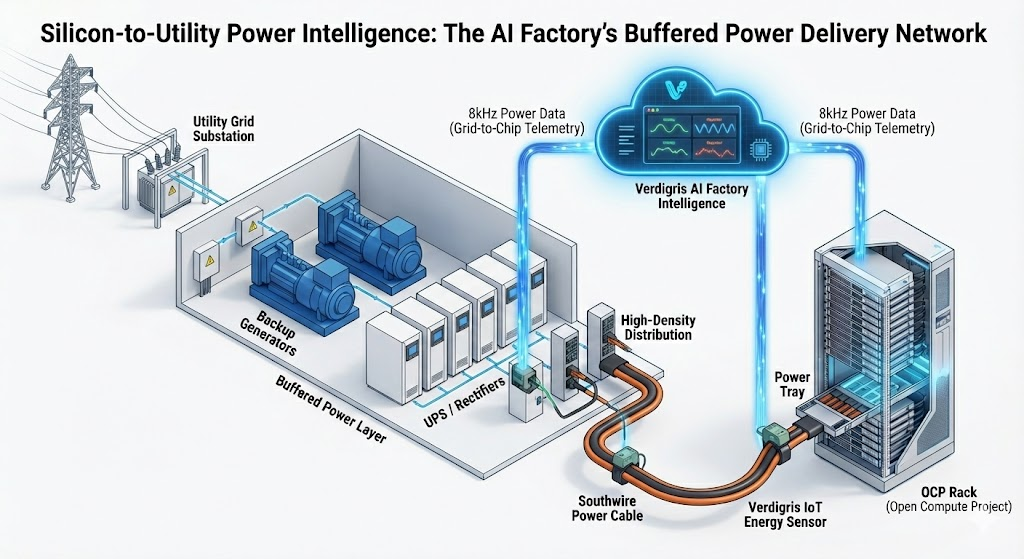
A Southwire + Verdigris perspective on power delivery in the AI era
AI changed what a "computer" is
As AI scales, the unit of compute is no longer a single chip. It's the rack.
That matters for power infrastructure. In the CPU era, the most intense current transients lived inside silicon and local VRMs. In the AI era, thousands of accelerators behave like one coordinated machine. They ramp together, spike together, idle together. What used to be a chip-level phenomenon now plays out across the rack's entire power delivery path.
The result isn't just higher power density. The power itself behaves differently: volatile, synchronized, and fast.
It's not just the load. It's how fast it changes.
At AI densities, the current flowing through the rack is fundamentally different in character.
The rate of change of current (di/dt) drives voltage transients, stresses terminations, accelerates thermal fatigue at connections, and can degrade copper paths in ways a steady load never would. As loads switch faster and more synchronously, the stacking effects compound, pushing volatility into the physical interconnect.
The copper path is where this volatility must travel. It's also where the most punishing physics often concentrates first, at connectors, junctions, and harness interfaces.
Telemetry exists. The interconnect is still dark.
Modern racks already have more sensors than ever. Power shelves ship with PMBus telemetry, servers report their own view, and facility systems observe upstream conditions. The industry is moving in the right direction, and standards like OCP's Open Data Center for AI initiative reinforce telemetry as a first-class requirement.
But today's visibility is still fragmented, measured at endpoints and managed in silos.
The cable harness connecting a power shelf to a compute tray is still passive copper. No sensing. No awareness of what's happening in the conductor. No signal from the terminations where failures often start.
So the system learns about cable-layer degradation late. There's no telemetry telling you a termination is fatiguing, a contact is drifting, or a harness is being repeatedly stressed by transient behavior. You find out when something trips.
The stack is getting smarter. The cable is next.
Every layer of the rack is becoming instrumented: power shelves, distribution, compute, software. The remaining gap is the one layer that connects everything: the interconnect.
At AI-scale power density and di/dt, the cable layer is no longer "just wiring." It's a real part of system reliability, performance headroom, and operational stability.
The next step is straightforward to state: make the copper path observable.
Why Southwire and Verdigris are joining forces
Verdigris has spent over a decade building electrical intelligence, capturing high-resolution waveform data and translating it into real-time insight on power quality, load behavior, and equipment health.
Southwire brings the other half: manufacturing scale, quality systems, and deep expertise building high-performance cable and interconnect products for demanding environments. Southwire manufactures roughly half of the wire and cable used to distribute electricity in the United States.
Southwire has made a strategic investment in Verdigris, and together we're defining what an intelligent cable layer should be for AI-scale infrastructure, and building toward the systems required to deliver it.
What we mean by "intelligent cable layer"
An intelligent cable layer isn't more dashboards. It's instrumentation where the stress actually occurs, paired with context from high-fidelity electrical measurements.
Practically, that means defining and building toward ways to instrument harnesses and terminations so they can surface early indicators of stress (thermal rise at interfaces, contact resistance drift, transient burden), and correlate those signals with rack-level waveform behavior so operators can distinguish normal volatility from degrading infrastructure.
The goal is a unified view of power delivery across the interconnect, not just isolated telemetry at the edges.
Verdigris: making copper transparent
Even our name is a nod to this. Verdigris is the patina that forms when copper is exposed. Our work is about exposure too: exposing what the conductor is experiencing so the system can respond before minor degradation becomes downtime.
About Southwire
Southwire is North America's leading wire and cable manufacturer. An $8.4B company with over 9,000 team members, Southwire manufactures roughly half of the wire and cable used to distribute electricity in the United States. Through Southwire Technology Ventures, the company invests in technologies that advance power delivery for next-generation computing environments.
Join the conversation
If you're designing OCP-compliant racks, operating at AI-scale densities, or pushing power delivery to new limits, we'd like to talk.
If you want to influence the definition of what this should look like, whether that's architecture, sensing strategy, OCP alignment, or deployment pathways, let's connect.